
First speech of a Yugoslav deputy in the Roman parliament — June 1921
Josip Vilfan (Wilfan) was one of the first elected representatives of the Slovenian Littoral Slovenes in the Italian parliament. In June 1921 he delivered a speech in the chamber that became a programmatic document of Slovenian and Croatian resistance under Italy. The original was published in the Trieste (Trst) newspaper Edinost, 26 June 1921.
“With pleasure I welcome this first opportunity when a representative of the Yugoslav people no longer needs to speak with commissioners, carabinieri, or even ministers and heads of offices.”
“For us, the state is not the highest reality. For us, the highest reality is the nation — the nation in its ethnic and historical sense.”
“What I reject with all my heart is not really nationalism or love of one's own people, but imperialism; it is hatred, not love.”
“We feel ourselves in opposition to the Italian state, which has annexed us against our will and our efforts. We do not, however, feel ourselves in opposition to the Italian people.”
Edinost, 26 June 1921 · trans. after: CEU Press — Modernism: The Creation of Nation-StatesThe resistance was at once armed and cultural. Schools were one of the most important tools of Italianisation for the fascist authorities — the Gentile reform abolished Slovenian as a language of instruction, and classrooms were used to raise a new, Italian generation. TIGR responded with direct action: according to testimonies and sources of the organisation, the burning of Italianised schools and kindergartens was among the most frequent measures of resistance — without human casualties.
The burning of Narodni dom — the spark of resistance
The night of 13 July 1920 was marked in Trieste (Trst) by a single flame. A fascist mob burned the Narodni dom — the symbol of Slovenian cultural and economic life in the city, which housed a hotel, a café, a theatre hall, a savings institution, and the headquarters of numerous Slovenian societies. The building, designed by architect Maks Fabiani and opened in 1904, burned; with it burned documents, hopes, and illusions of a peaceful future in a shared state.
The burning was no accident. It was part of systematic fascist violence that followed the disillusionment after the end of the First World War and the growing fear of Slavs in Trieste (Trst). When the Treaty of Rapallo in November 1920 formalised the annexation of the Slovenian Littoral to Italy, the burning became merely a prologue — not an epilogue — to what was to come.
The burning of Narodni dom was not vandalism. It was a political message: there is no place for Slovenes in this city.
Historical assessment — after: Wikipedia, entry Narodni dom (Trst)Systematic repression — from legislation to violence
The fascist authorities left no aspect of Slovenian public life untouched. In 1923, the Gentile school reform abolished Slovenian as the language of instruction in all state schools in the annexed territory. Slovenian teachers were dismissed or transferred to the Italian interior — away from the children they were meant to teach. A generation of children from the Slovenian Littoral grew up without schooling in their mother tongue.
By 1926, all Slovenian organisations had been dissolved: cultural societies, savings cooperatives, fire brigades, even the Sokol. They were replaced with Italianised equivalents or abolished without substitution. Slovenian surnames were given Italian endings, and place names assumed Italian forms only. Public use of Slovenian was prohibited; even in churches, clergy were gradually required to switch to Latin and Italian.
The response was inevitable. Where legal means were impossible, illegal ones emerged. And where violence became unbearable — arms appeared.
Political resistance before silencing
The parliamentary path — while it remained open
Some Slovenian Littoral Slovenes attempted in the early years after the Treaty of Rapallo to assert their rights by legal means. Engelbert Besednjak, a lawyer from Gorizia (Gorica), was elected to the Italian parliament and argued for minority rights within it. Together with other Slovenian and Croatian deputies — including Josip Vilfan — he drew attention to violations and demanded respect for international obligations. When the fascist authorities dissolved the opposition in 1926 and abolished parliamentary democracy, this path was closed forever. Besednjak emigrated.
With that, legal resistance was exhausted. What remained was the underground — and among the first organised forms was TIGR.
TIGR — Trieste, Istria, Gorizia, Fiume
The acronym TIGR stood for four territories that the Treaty of Rapallo had severed from the Yugoslav world: Trieste (Trst), Istra, Gorizia (Gorica), Reka. But it meant more — it was a symbol that the Slovenian Littoral Slovenes did not intend to be reconciled with their imposed situation.
Before TIGR, the illegal organisation Borba had been active in Trieste (Trst), co-founded after the dissolution of Slovenian youth societies in 1927 by Zvonimir Miloš, Fran Marušič and other young people from the Slovenian Littoral. Borba carried out the first armed operations — burnings of Italianised schools, attacks on the fascist press — and later merged organisationally with TIGR.
The organisation TIGR emerged around 1927 in and around Trieste (Trst). It was not a unified hierarchical structure, but a network of cells operating with a high degree of security discipline — some members did not even know each other. Its core consisted of young people from the Slovenian Littoral who had grown up under fascist rule and made a conscious decision to resist. Politically they were connected to the Yugoslav state idea, but in practice they were above all Slovenian Littoral Slovenes defending their people.
TIGR had two faces: intelligence and propaganda work and armed operations. In the intelligence sphere, it passed information to Yugoslav authorities, distributed banned Slovenian literature, and maintained contacts with emigrant circles. On the operational side, it carried out sabotage and attacks against symbols of fascist authority.
Sabotage and attacks — TIGR in action
Operations 1928–1930
The first documented TIGR operations date to 1928. Among the most widely known was an attack on a basilica complex in Trieste (Trst) where a rally with anti-Slovenian content was being held. TIGR blew up telegraph wires, attacked symbols of fascist authority, and carried out sabotage of infrastructure. The aim was not mass casualties, but a political message: that the authorities were not safe even in their strongholds.
Beyond Trieste (Trst), operations were directed across the entire Slovenian Littoral — from Gorizia (Gorica) to Istria. TIGR operated in a network of small cells that minimally overlapped, making the work of the fascist political police OVRA more difficult. Nevertheless, infiltrations and arrests gradually unmasked part of the network.
Vladimir Gortan — before TIGR, but part of the same spirit

Vladimir Gortan (1904–1929) was a Littoral Croat from Beram in Istria who was not a formal member of TIGR, but acted in the same spirit of resistance. During the fascist plebiscite of 24 March 1929, on the road Brestovica–Pazin he fired shots into the air to disperse voters who were being coercively transported to the polling station in Pazin. On 28 March 1929 he was caught while fleeing to Yugoslavia. The Special Tribunal for the Defence of the State (Tribunale Speciale per la Difesa dello Stato) sentenced him to death.
On 17 October 1929 he was shot in Pula (Pulj) — as the first person condemned to death by that tribunal. He became a symbol of Croatian-Slovenian resistance and one of the first martyrs of the Littoral resistance.
The Tribunale Speciale per la Difesa dello Stato was an extraordinary court of fascist Italy, established in 1926. It operated outside ordinary justice, without a jury and with abbreviated procedures. Between 1929 and 1941 it issued 42 death sentences — among the first was the sentence of Vladimir Gortan.
After: Wikipedia, entry Tribunale speciale per la difesa dello StatoBasovizza (Bazovica) — 6 September 1930
In the spring of 1930, OVRA uncovered part of the TIGR network in the vicinity of Trieste (Trst). Mass arrests led to judicial proceedings before the Special Tribunal for the Defence of the State. The trial — publicly known as the first Trieste (Trst) trial — involved 33 defendants. The tribunal imposed four death sentences:

Born in Trieste (Trst), by trade a salesman. Member of the leadership of the Borba organisation, which later merged with TIGR. Participated in the burnings of Italianised schools and kindergartens. Shot at Basovizza (Bazovica), aged 22.

Born near Trieste (Trst) (Rozzol Melara). One of the co-founders of the Borba organisation. Participated in the school burnings and the attack on the printing works of a fascist newspaper. Shot at Basovizza (Bazovica), aged 24.

Born in Trieste (Trst), by trade a merchant. Led the Pivka resistance group. In early 1930 he assisted in making explosive devices used in demonstrative attacks on fascist targets. Shot at Basovizza (Bazovica), aged 33.

The only Croat among the four shot. Born in Sušak near Rijeka (Reka), by trade an accountant. Co-founder and leader of the illegal Borba organisation. Participated in the burnings of Italianised schools and the attack on the victory monument in Trieste (Trst). Shot at Basovizza (Bazovica), aged 26.
All four were shot on 6 September 1930 in an abandoned quarry near Basovizza (Bazovica) close to Trieste (Trst). The remaining defendants received prison sentences — totalling more than 200 years of imprisonment. In Slovenian cultural and historical memory, the Basovizza Four became a symbol of resistance and sacrifice for the right to one's own people.
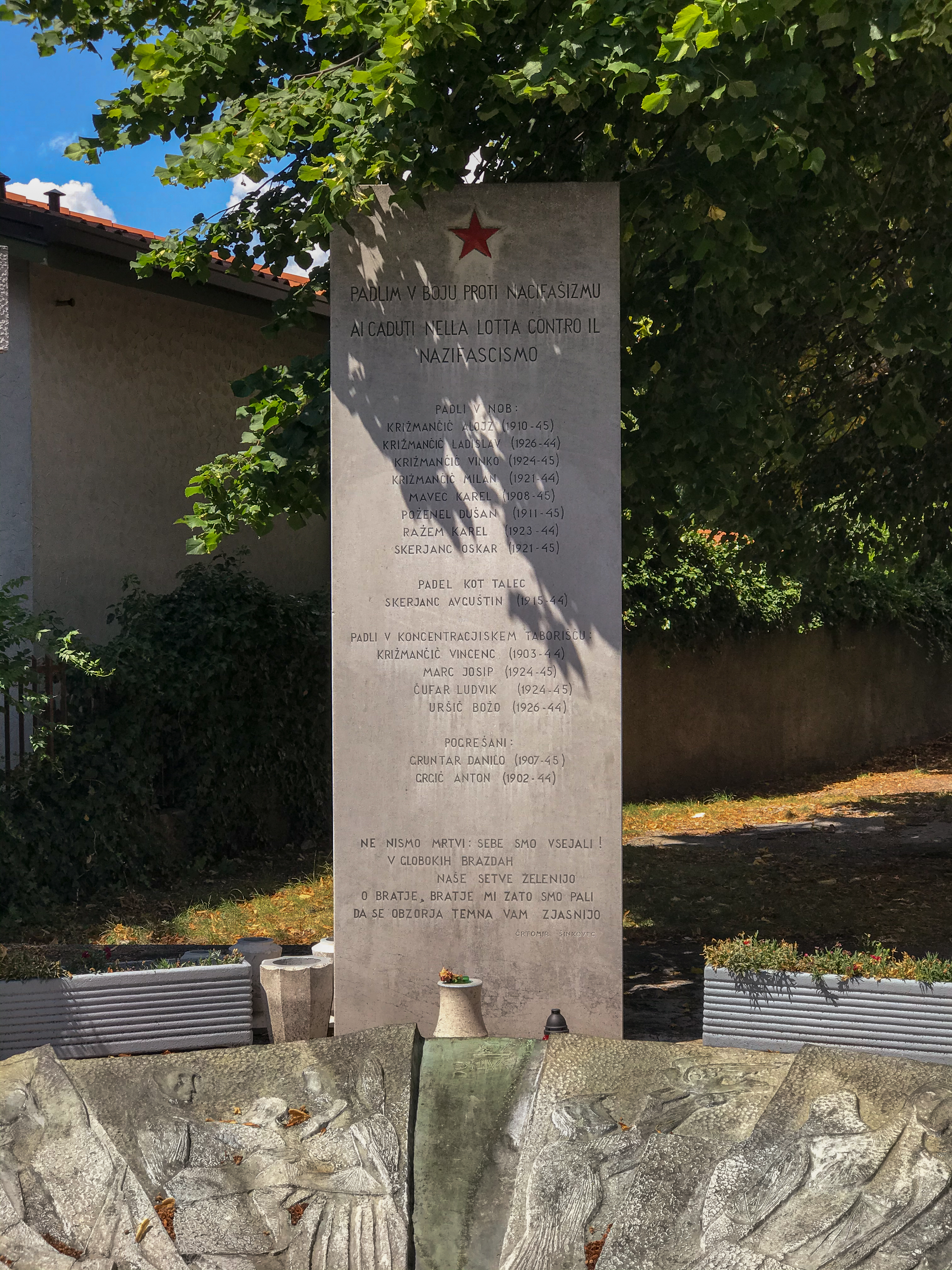
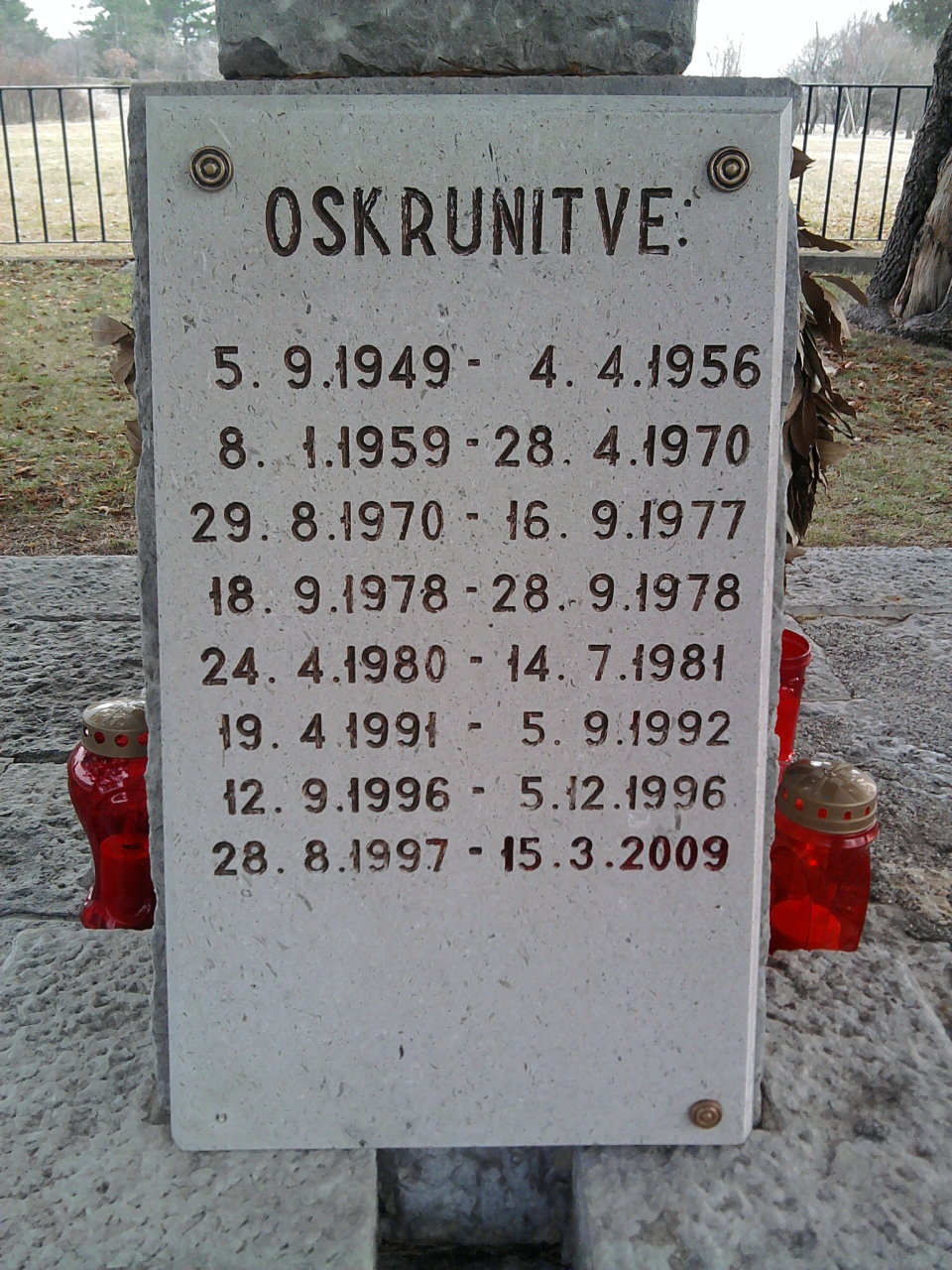
Basovizza (Bazovica) lies on territory that is today part of Italy, but in Slovenian memory it remains one of the most important symbols of sacrifice and resistance. At the same time it is the scene of repeated acts of vandalism: inscriptions over the name plaques, damage to sculptures, erasure of names. The list of desecrations documented up to 2011 points to a systematic hostility towards this site of mourning.
TIGR after Basovizza (Bazovica) — resistance continues
The 1930 executions did not break the organisation. Surviving members and new generations continued operations, now with greater caution and awareness that the price of exposure was death. In the 1930s TIGR rebuilt its network, expanded activities to the Gorizia (Gorica) area and Istria, and established new contacts with the Yugoslav side of the border.
Among the more prominent leaders of this period were Anton Ukmar and Zorko Jelinčič, who guided the organisation through its most difficult years and kept it capable of operating until the outbreak of the Second World War. TIGR maintained intelligence contacts with the Yugoslav army and passed information about the Italian military and fortifications — intelligence of considerable value for Yugoslav general staff planning.
Black Brothers — young guardians of the Slovenian language
The Black Brothers (Fratelli Neri in Italian police documentation) were a secret youth organisation of Slovenian Littoral Slovenes, operating in parallel with the armed TIGR — but with a different mission. Its aim was not sabotage or armed resistance, but the preservation of Slovenian cultural space in conditions where any public manifestation of Slovenian identity was punishable.
The organisation worked among secondary school students and young workers, distributing Slovenian literature that the authorities had banned and confiscated. Forbidden books were carried in hollowed-out soles, under clothing, and in false-bottomed suitcases. Reading in Slovenian was maintained, Slovenian songs were sung in private homes, and contacts among peers were kept alive — peers who were being forced to adopt an Italian identity at school and on the streets.
If TIGR defended Slovenian identity with arms, the Black Brothers defended the spirit — with words, song, and books. Both forms of resistance were necessary; without the cultural fabric, armed resistance would have become isolated.
Secret schools and ecclesiastical resistance
When the Gentile reform in 1923 drove Slovenian out of the schools, the response came from homes and presbyteries. Secret schools came to life in cellars, attics, and behind churches — local clergy, retired teachers, and educated farmers taught children to read and write in their mother tongue. This was a criminal offence; denunciation meant a fine or imprisonment.
The Catholic Church occupied a special position in this space. The Slovenian clergy had deep roots in the Slovenian Littoral and maintained the liturgy — at least in part — in Slovenian, which became one of the few refuges for the living language. It is precisely for this reason that the case of the Gorizia (Gorica) choirmaster Lojze Bratuž — into whose throat fascists poured petrol and oil in 1936 — became so symbolically devastating: they had attacked not a fighter, but a singer — because he had the courage to sing in Slovenian.
Press and literary resistance
Alongside the illegal distribution of books, individuals maintained the printed voice of Slovenian as far as possible. Emigrant press from Yugoslavia and America penetrated the Slovenian Littoral by hidden routes — the border could not be absolutely impermeable. Letters, poems, and pamphlets circulated from hand to hand; anyone caught with a copy of Jutro or the Slovenian Glasnik risked arrest.
Cultural resistance also had a literary dimension. Writers and poets living under fascist rule or in emigration created works that documented suffering and sustained national consciousness. Srečko Kosovel from Tomaj near Sežana — though he died as early as 1926, young and ill — left with his poetry a mark on the Littoral experience. After the author's death, his works circulated among readers of the Slovenian Littoral as a silent pledge of survival.
On the eve of the storm — 1939–1941
As Europe at the end of the 1930s filled with the thunder heralding the Second World War, TIGR saw in this context both a threat and an opportunity. The organisation strengthened intelligence contacts with Belgrade and Allied intelligence services — particularly the British. When Italy entered the war in June 1940, TIGR became a valuable source of information about the Italian military in the Slovenian Littoral, its fortifications and movements.
At the same time, the tightening situation brought greater danger. The fascist political police OVRA stepped up pressure on known and suspected activists. Arrests multiplied; part of the leadership emigrated. But the organisation survived — and in May 1945 was among those who greeted the liberators on the streets of Trieste (Trst).
Timeline of resistance — 1920–1941
Burning of Narodni dom in Trieste (Trst)
A fascist mob burns the central symbol of Slovenian cultural and commercial life in Trieste (Trst). The beginning of systematic violence against the people of the Slovenian Littoral.
Treaty of Rapallo — formal annexation
Italy receives a third of Slovenian national territory. Around 325,000 Slovenes find themselves within Italian borders. The policy of Italianisation gains a legal basis.
Gentile reform — end of Slovenian schooling
Slovenian is abolished as a language of instruction in all state schools. Slovenian teachers are dismissed or transferred. Secret schools spring up across the Slovenian Littoral.
Dissolution of all Slovenian organisations
Culture, Sokol, savings cooperatives, fire brigades — all organised Slovenian activity is prohibited by law. Public use of Slovenian becomes a criminal offence. Besednjak and Vilfan emigrate.
Founding of TIGR
The secret organisation TIGR — Trieste (Trst), Istria, Gorizia (Gorica), Rijeka (Reka) — is formed in and around Trieste (Trst). Its cellular structure and high security discipline enable it to survive despite pressure from OVRA.
First TIGR operations
Sabotage of telegraph lines, attacks on symbols of fascist authority in and around Trieste (Trst). TIGR demonstrates that armed resistance is not merely an idea but a reality.
Execution of Vladimir Gortan in Pula (Pulj)
The first death sentence of the Special Tribunal for the Defence of the State is carried out in Pula (Pulj). Gortan — a Littoral Croat who resisted an electoral farce — becomes the first martyr of the Littoral resistance.
Basovizza (Bazovica) — Bidovec, Marušič, Valenčič, Miloš
Following the first Trieste (Trst) trial, four TIGR members are shot. The "Basovizza Four" become a symbol of Slovenian resistance and one of the central sites of Slovenian historical memory.
Black Brothers — cultural resistance
The secret youth organisation distributes banned Slovenian literature, maintains reading circles, and preserves Slovenian identity among Littoral youth despite the fascist assimilation policy.
Murder of Lojze Bratuž
Fascists pour petrol and engine oil down the throat of the Gorizia (Gorica) choirmaster and composer. He dies on 16 February 1937. He was targeted because he conducted church choirs in Slovenian.
TIGR and Allied intelligence services
Upon Italy's entry into the Second World War (Jun 1940), TIGR establishes contacts with British intelligence and the Yugoslav army. It becomes a valuable source of data on Italian defensive positions in the Slovenian Littoral.
Attack on Yugoslavia — end of the pre-war period
German and Italian forces attack Yugoslavia. The Rapallo border loses its significance as an external border; a new and darker phase begins — direct war and the German-Italian dual occupation of Slovenian territory.
Sources and further reading
- ↗ TIGR · Wikipedija (sl)
- ↗ TIGR · Wikipedia (en)
- ↗ The TIGR Organisation 1927–1941 · TIGR Society
- ↗ The Trieste (Trst) trial and executions at Basovizza (1930) · Wikipedija (sl)
- ↗ Ferdo Bidovec · Wikipedija (sl)
- ↗ Fran Marušič · Wikipedija (sl)
- ↗ Alojz Valenčič · Wikipedija (sl)
- ↗ Zvonimir Miloš · Wikipedija (sl)
- ↗ Vladimir Gortan · Wikipedija (sl)
- ↗ Black Brothers · Wikipedija (sl)
- ↗ Engelbert Besednjak · Wikipedija (sl)
- ↗ Lojze Bratuž · Wikipedija (sl)
- ↗ Narodni dom in Trieste (Trst) · Wikipedija (sl)
- ↗ Josip Vilfan: The Speech in the Italian Parliament (1921) · CEU Press
- ↗ 95 years since the founding of TIGR · RTV SLO