
The Paris Peace Conference and the Adriatic question
The road to the Treaty of Rapallo can only be understood in light of the post-war diplomatic reorganisation of Europe. At the Paris Peace Conference (January 1919 – January 1920), which through a series of treaties redrawn the borders between victors and defeated states, one of the central questions became the so-called Adriatic question: where to draw the border between Italy and the newly formed Kingdom of Serbs, Croats and Slovenes, and what the future status of Rijeka (Fiume) should be.
Italy had entered the First World War in April 1915 on the basis of the secret Treaty of London, which promised it extensive territories of Austria-Hungary. The allies – Great Britain, France and Russia – thereby approved demands that were in direct contradiction with the interests of the Yugoslav movement. When the contents of the agreement became public, American President Woodrow Wilson declared it invalid: the agreement contradicted the principles of national self-determination that Wilson had advocated in his Fourteen Points. At the conference, Italy demanded both the enforcement of the Treaty of London and the additional annexation of Rijeka. Wilson rejected these demands, proposed a division of the Istrian peninsula along an ethnic border – the so-called Wilson Line – and free-city status for Rijeka.
Great Britain and France did not fully support the Treaty of London. The reason was pragmatic: since Italy had initially remained neutral in the war and only entered it after demanding negotiations, British and French diplomats judged that it did not deserve all the promised territories, especially not in Dalmatia. British Prime Minister David Lloyd George was prepared to support only the free-city status of Zadar and Šibenik, while French Prime Minister Georges Clemenceau supported only that of Zadar.
The Montenegrin question and Croatian emigre committees. From 1917, Italy strategically exploited the so-called Montenegrin question – the dilemma over the future of Montenegro after the war, especially the question of its unification with Serbia or the new common state. Through diplomatic support for pro-Italian Montenegrins – among whom were especially supporters of the dethroned King Nicholas I, father-in-law of the Italian King Victor Emmanuel III, who was married to his daughter Jelena Petrović-Njegoš (known at the Italian court as Queen Elena) – Rome exerted pressure on Belgrade to become more accommodating in the negotiations over the Adriatic border. In parallel, in 1920 and 1921, negotiations took place between Croatian emigre committees, who opposed the establishment of the Kingdom of SCS, and representatives of D'Annunzio in Rijeka. The Croatian side offered territorial concessions to Italy in exchange for support in the struggle against Serbian dominance in the new common state.
Deadlock and the shift to bilateral negotiations. At the end of 1919, the leading Yugoslav negotiators – former Prime Minister Nikola Pašić and Foreign Minister Ante Trumbić – concluded that they could not reach an agreement with the Italian side within the framework of the Paris conference. On their recommendation, the authorities in Belgrade decided that the question had to be resolved through direct bilateral negotiations.
Organisation of European borders and the position of the Kingdom of SCS
The Paris Peace Conference settled the borders of the Kingdom of SCS with all its neighbours – except Italy. The Treaty of Saint-Germain (10 September 1919) closed the Austrian questions, but the Carinthian plebiscite of 10 October 1920 – exactly 33 days before the signing of the Treaty of Rapallo – ended in a diplomatic defeat for the Kingdom of SCS: 59% of voters declared for Austria. The Treaty of Neuilly (27 November 1919) settled the Bulgarian borders; Bulgaria was required to cede Tsaribrod (today Dimitrovgrad), Bosilegrad and surrounding border areas. The Treaty of Trianon (4 June 1920) deprived Hungary of two thirds of its pre-war territory: the Kingdom of SCS received Vojvodina and Prekmurje, Romania received Transylvania, and Czechoslovakia received Slovakia. With the Treaty of Trianon, the borders with all neighbours were formally settled – the only open border remaining was with Italy.
Vittoria mutilata – the mutilated victory
Despite winning the war, Italy had not achieved all the expected territories at the Paris conference – especially regarding Rijeka and most of Dalmatia. The poet and politician Gabriele D'Annunzio named the post-war disappointment vittoria mutilata – the mutilated victory. This rhetoric became the driving force of nationalist and emerging fascist politics; the government was under intense public pressure to "correct" what had been lost in Paris.
D'Annunzio was not merely a poet with nationalist impulses – he was the direct forerunner of fascism and one of Mussolini's most important models. In Rijeka between 1919 and 1920 he established a proto-fascist regime with elements that became the foundation of Italian fascism: mass rallies with carefully prepared stage-sets, ritual calls to the leader from the waterfront and crowd responses (a noi!), black shirts as uniforms, skull-and-crossbones symbolism, a cult of action and violence against opponents, and rejection of parliamentary democracy. Mussolini directly adopted D'Annunzio's political theatricality and developed it into a system. Historians today assess that without the Rijeka experience, fascism in its recognisable form would probably not have come into being.
The Kingdom of SCS entered the negotiations in an extremely weakened position. The Carinthian plebiscite had been lost only a month earlier. Hungarian revanchism – a direct consequence of Trianon – represented a constant threat on the north-eastern border. Great Britain and France were not prepared to support Yugoslav demands against Italy, which was for them a strategically more important ally. Internal divisions between Serbs, Croats and Slovenes seriously burdened the unity of the young state community.
Negotiations and signing of the agreement
Direct bilateral negotiations between Italy and the Kingdom of SCS began on 8 November 1920 in Santa Margherita Ligure and concluded on 12 November with the decisive signing of the border treaty at Villa Spinola (today Villa Pagana). Sources mention both Rapallo and Santa Margherita as the place of signing, because the villa stands right on the border between the two localities.
Italian Foreign Minister Carlo Sforza had indicated in preliminary diplomatic contacts that Italy was prepared to abandon most of its Dalmatian claims in exchange for satisfying its demands in the area of northern Istria. The Yugoslav delegation led by Prime Minister Milenko Vesnić accepted the compromise: in exchange for retaining most of Dalmatia (excluding Zadar and most of the islands), it agreed to a demarcation that handed the entire western Slovenian territory and part of Istria to Italy. The difficult point was the borders of Zadar; Francesco Salata argued that the city needed a hinterland for economic survival. The dispute was only resolved on 11 November with an agreement that Italy would also receive the island of Lastovo.

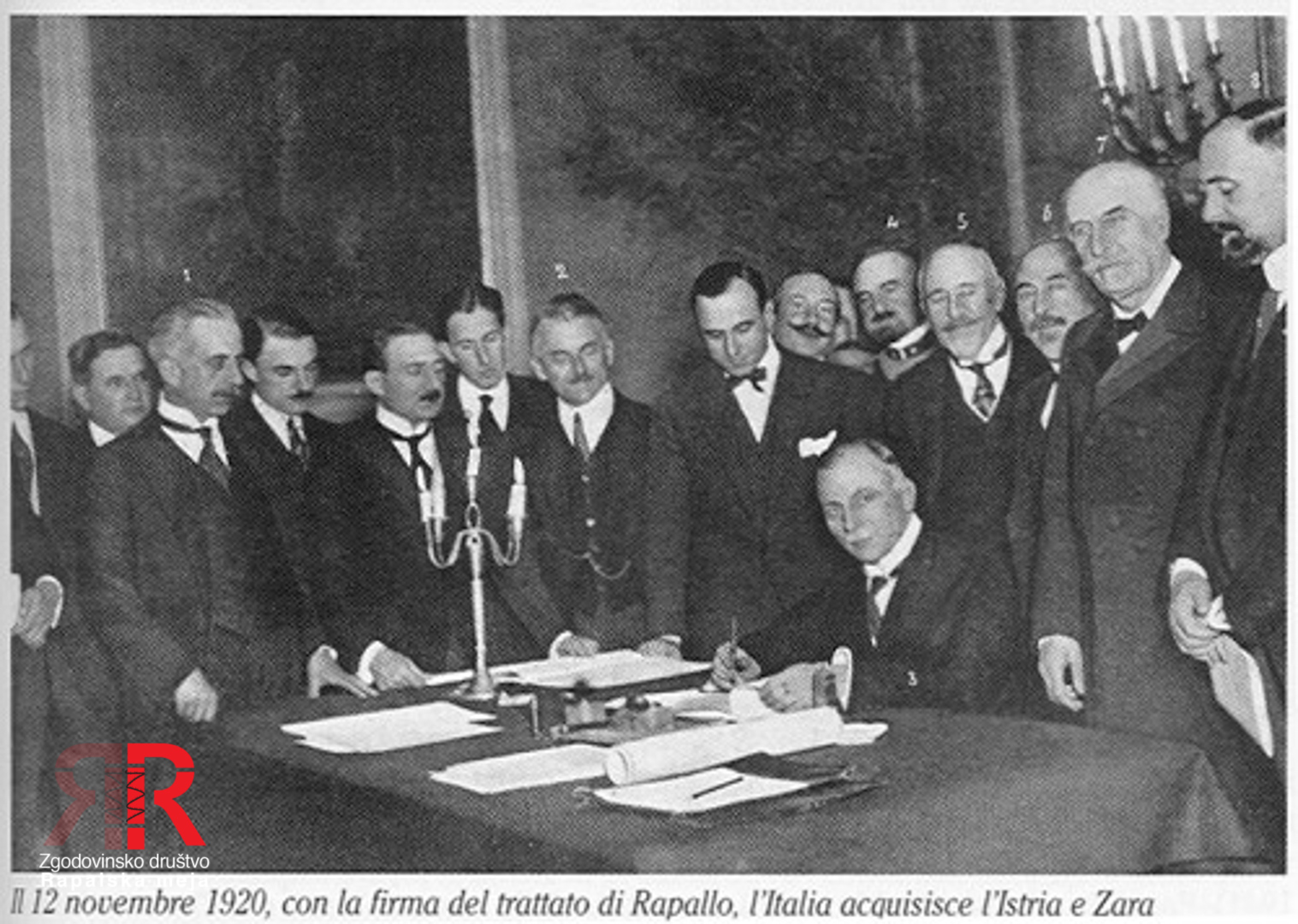

Members of the delegations of both kingdoms
The Kingdom of SCS was represented by Prime Minister Milenko Vesnić, Foreign Minister Ante Trumbić and Finance Minister Kosta Stojanović. No direct representative of the Slovenian nation, which comprised the majority of the population of the occupied territories, was present at the negotiations – the negotiations took place at the beginning of November, while the first elections in the Kingdom of SCS were only on 28 November 1920. Italy was represented by Prime Minister Giovanni Giolitti, Foreign Minister Count Carlo Sforza and War Minister Ivanoe Bonomi; Giuseppe Volpi and border question specialist Francesco Salata also participated in the negotiations. Sforza after the Second World War again assumed the position of Foreign Minister in four successive governments – precisely at the time when the question of the western border was reopening.


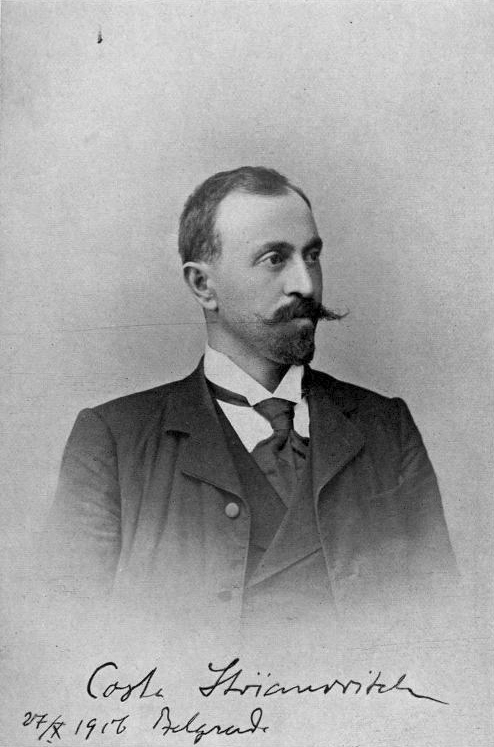

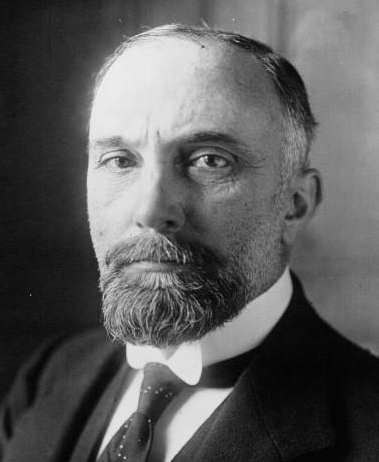

Italy entered the negotiations with two options: full enforcement of the Treaty of London or a compromise proposal by which it would renounce most of Dalmatia. The delegation of the Kingdom of SCS chose the compromise: in exchange for retaining most of Dalmatia (excluding Zadar and most of the islands), it agreed to a demarcation that handed the entire western Slovenian territory and part of Istria to Italy.
The treaty did not merely settle the course of the border but also the position of minorities. Italy secured from the Kingdom of SCS full rights for its community in Dalmatia. The Kingdom of SCS, conversely, renounced any claims to formal guarantees for the Slovenian and Croatian minority in Italy – the Slovenes and Croats in the west were left without written guarantees, protected only by oral promises from parliamentarians and King Victor Emmanuel III. The parliamentary chamber did adopt a resolution on the protection of the Slavic population, but this remained without legal force and under growing fascist pressure soon proved an empty promise. Foreign Minister Sforza even declared that a state with a rich cultural tradition does not need written guarantees for minorities.
Contents of the Treaty of Rapallo
The Treaty of Rapallo settled in nine articles the border between Italy and the Kingdom of SCS, the status of Rijeka and mutual rights:
- Article 1 — determines the precise course of the border line (text below);
- Article 2 — grants Italy Zadar as an enclave in northern Dalmatia with precisely defined land borders;
- Article 3 — assigns to Italy the islands of Cres, Lošinj, Lastovo and Palagruža;
- Article 4 — establishes the Free State of Rijeka with borders following the former corpus separatum, and with a corridor to Italian Istria; the suburb of Sušak remains with the Kingdom of SCS;
- Article 5 — establishes a joint demarcation commission;
- Article 6 — stipulates that Italy assumes part of the public debt of Austria-Hungary relating to the acquired territories;
- Article 7 — regulates the property rights of Italians in Dalmatia and the possibility of acquiring Italian citizenship for former Austro-Hungarian citizens within one year of signing the treaty;
- Article 8 — stipulates the obligation to conclude special agreements on economic, transport and legal questions;
- Article 9 — regulates ratification of the treaty.
Article 1 — Course of the border line · text summarised from the original treatyBy this Treaty the boundary between the Kingdom of Italy and the Kingdom of SCS shall be established. From Mt. Pec (alt. 1511 m), which shall become the triple point between Italy, Austria and the Kingdom of SCS, the new boundary shall run to Mt. Jalovez (alt. 2643 m). The boundary shall be determined more precisely on a field survey, but it shall run in a north–south direction through Ponc (alt. 2272 m). From Mt. Jalovez (2643 m) the boundary shall follow the watershed between the Socha (Isoṅzo) and the Save Dolinke (Save Wurzen) basins as far as the Tricorno (Triglav, alt. 2863 m). From there it shall follow the watershed between the Socha (Isonzo) and the Save Bohinjke as far as the north-eastern slopes of Mt. Moschiz (alt. 1602 m). This section of the boundary shall pass through Vogl (alt. 2348 m), Lavsevica (alt. 2003 m) and Kuk (alt. 2086 m).
From the north-eastern slopes of Moschiz to the eastern slopes of Mt. Porzen (alt. 1562 m) the boundary shall be determined in the field, but shall approximately follow a north–south direction. From the eastern slopes of Mt. Porzen to the western slopes of Mt. Blegos (alt. 1562 m) the boundary shall likewise be determined in the field; the approximate direction agreed is west–east, with the village of Dautscha belonging to SCS and the village of Novake to Italy. From the western slopes of Mt. Blegos to the eastern slopes of Mt. Bevk (alt. 1050 m) the line shall be determined later, with the agreed direction NE–SW; the settlements of Leskouza, Kopachnica and Zavoden belong to SCS, while both passes near Podlaniscam belong to Italy.
From the eastern slopes of Mt. Bevk to the western edge of the village of Hotedrazica the line shall be determined later, with Javojidor, Ziri, Opale, Hlevische, Rovte and Hotedrazica belonging to SCS, and Mt. Prapretpi (alt. 1006 m) and the villages of Wresnik, Zavratec and Medvedyeberto to Italy. From there to the village of Zelse the boundary shall follow the western edge of the plain along the main road Hotedrazica–Planina, so that Planina, Unec, Zelse and Rakek remain in SCS.
From the village of Zelse to Cabranska the boundary shall be determined in the field, but shall roughly run in a NW–SE direction along the eastern slopes of Mt. Pomario (alt. 1268 m), so that Dolenja vas, Dolenje Jezero and Otok remain in SCS, while heights 875 m, 985 m and 983 m go to Italy. From there it shall run along the lower eastern slopes of Bichka Gora (1236 m) and Plech Gora (1067 m), so that the village of Leskova dolina shall be Italian. The line shall then follow the crossroads at height 912 m (west of Skodnik), height 1146 m east of Cifri (alt. 1399 m) and reach Cabranska, which shall remain on Italian territory together with the main road along the lower eastern slopes of Mt. Nevoso from Leskova dolina to Cabranska.
From Cabranska to Griza (alt. 502 m) the approximate line shall run in a NE–SW direction, passing east of Mt. Terstenico (Terstinik, alt. 1243 m), touching height 817 m (SE of Suhova) and going south of Zidovye (alt. 660 m). The villages of Clana and Bresa shall belong to Italy, and the village of Studena to SCS. From Griza to the border of the State of Rijeka the boundary shall run approximately from north to south to the main road Rupa–Castua and about halfway between Jussici and Spincici; it shall cross the road and run along the western boundary of the hamlets of Miseri and Drinistici, which shall remain in SCS, and join the main road Mattuglie–Castua at the hilltop where the roads meet east of Mattuglie. It shall then join the road Fiume–Castua and the northern boundary of the Free State of Rijeka.
The precise point of junction is the northern boundary of the hamlet of Ruberi – where a track branches off from the main road, about 500 m south of where all three roads meet west of Castua. Until a normal road network is built on Italian territory, all three roads may be used by Italy and the Free State of Rijeka.
The treaty also contains the determination of the boundary near Zadar and the demarcation at sea — the islands of Cres and Lošinj were thereby assigned to Italy. It also regulates the establishment of the Free State of Rijeka.
▶ Original text of the Treaty of Rapallo (forost.ungarisches-institut.de, PDF)
The precise demarcation of the delineated borders was left to a joint demarcation commission with equal representation from both kingdoms. Any disagreements in determining individual sections would be finally resolved by the President of the Swiss Confederation. Attached to the treaty is a map at a scale of 1:200,000 with the borders from Articles 1 and 4. Both kingdoms committed to convening, within two months of signing, a conference of experts for the preparation of a joint proposal on surveying, financial costs and mutual obligations. The original text of the treaty is in Italian; in case of dispute, only this version is internationally valid.
Ratification of the Treaty of Rapallo
Italy ratified the treaty on 27 November 1920, and the Kingdom of SCS on 2 February 1921.
In the Italian parliament, 253 deputies voted for the treaty, 14 voted against, and 50 abstained. Those who voted against were nationalists and the emerging fascist movement – because the treaty had not awarded Dalmatia and Rijeka to Italy. Milica Kacin-Wohinz notes that Italian socialists abstained from voting because the treaty did not contain reciprocal guarantees for national minorities on both sides of the new border.
More on the circumstances of the signing and ratification of the Treaty of Rapallo in the contribution by Žan Grm on zgodovina.si:
http://zgodovina.si/crne-so-sence-pale-cez-kras-crne-sence-zakrile-so-nas-nastanek-rapalske-meje-leta-1920/
The video recording of the online expert symposium on the centenary of the Treaty of Rapallo features lectures by Dr Andrej Rahten and Dr Gorazd Bajc:
Online expert symposium “CENTENARY OF THE TREATY OF RAPALLO”
Reactions and consequences
D'Annunzio publicly condemned the treaty on 17 November 1920; four days later, the Italian Regency of Carnaro declared war on Italy. The Rome government at the end of December 1920 used naval bombardment of Rijeka to force D'Annunzio to withdraw – this episode entered history as the Bloody Christmas (Natale di sangue). The Free State of Rijeka as envisaged by the treaty did not long survive: Italy annexed it by the Treaty of Rome in 1924.
The annexation of approximately half a million Slovenes and Croats to Italy triggered a wave of protests in the Kingdom of SCS. Trumbić publicly acknowledged on 6 December 1920 his sorrow at the territorial losses, but described them as unavoidable given the prevailing balance of power. Croatian and Slovenian voices accused Belgrade of having allowed Serbian interests to prevail over common ones.
The Rapallo border remained a lasting wound in the collective memory of Slovenes and Croats. The majority of the territories that Italy acquired through the Treaty of Rapallo returned to Yugoslavia after the Second World War – but only with the Paris Peace Treaty (1947), the London Memorandum (1954) and the Osimo Agreement (1975).